9 Best Air Purifiers Under $200 (October 2026)
The best air purifiers under 200 dollars include the Levoit Vital 200S-P for larger pet rooms, the Levoit Core 300-P for quiet bedrooms, and the Winix 5510 for app-based odor control.
On this page (4 sections)
The best air purifier under 200 dollars for a larger room is the Levoit Vital 200S-P, with AHAM-verified CADR ratings for smoke, dust and pollen. For a bedroom, the Core 300-P has a defined small-room cleaning rate and quiet Sleep Mode; for app control and odor features, consider the Winix 5510.
This roundup compares 9 models for room size, cleaning rate, filter care, odor features and controls. The right choice depends on how much air you need to clean, how often the room is occupied and which routine you can maintain.
Start with the room where the purifier will run most. Our guide to choosing the best air purifier for your home explains how to match capacity and features to a room's needs.
Our picks at a glance
-
1

-
2

-
3

Best air purifiers under 200 dollars by room and routine
The Vital 200S-P is the leading fit for larger rooms in this group, while the Core 300-P makes a clearer bedroom choice. The other picks trade room capacity, automation, odor control and filter care in different ways.
Levoit Vital 200S-P: Best for larger pet rooms
- AHAM-verified
- Smoke CADR 250 CFM
- Dust CADR 254 CFM
- Pollen CADR 289 CFM
- U-shaped air inlet
Its stated large-room coverage and separate CADR figures make it the most clearly documented fit for a larger shared space. The extra U-shaped inlet is designed to help draw in pet hair and odors.
Pros
- AHAM-verified
- Separate smoke, dust and pollen CADR ratings
- Two air inlets
Cons
- Larger footprint than compact bedroom picks
- Coverage figure alone does not show air changes per hour
The Vital 200S-P is the strongest fit here if you need one purifier for a larger living area or an open room. Levoit gives separate AHAM-verified CADR ratings: 250 CFM for smoke, 254 CFM for dust and 289 CFM for pollen.
Its stated coverage reaches up to 1,875 sq ft, and the dual-inlet design includes a U-shaped opening intended to draw in pet hair and odors. Levoit describes the model as designed for allergy groups and high-traffic spaces.
Choose it for a shared room or pet household where a larger stated area and the extra inlet are useful. Skip it for a small bedroom if a compact unit would suit the room better, and confirm the cleaning rate you need rather than relying on the maximum coverage figure alone.
Levoit Core 300-P: Best for quiet bedrooms
- AHAM-verified
- Smoke CADR 143 CFM
- Sleep Mode at 24 dB
- Display lights can be turned off
A quiet Sleep Mode and a defined bedroom-size coverage figure make this an easy choice for a sleeping space. It has no Auto Mode, so you set the fan speed yourself.
Pros
- AHAM-verified
- Sleep Mode rated at 24 dB
- Display lights turn off
Cons
- No Auto Mode
- The 1,073 sq ft figure is for one air change per hour
The Core 300-P suits a bedroom if you want a defined room size and a quiet mode. It refreshes a 222 sq ft room 4.8 times per hour, and Sleep Mode runs at 24 dB.
Its smoke, dust and pollen CADR ratings are 143, 153 and 167 CFM. You can turn the display lights off, set a timer and check the filter indicator.
This model uses manual fan-speed control and has no Auto Mode. Set a speed that fits your routine, then adjust it when the room's needs change.
Choose it for a bedroom or office where quiet operation and a useful room-size benchmark matter. Skip it if you want a sensor to change fan speed for you.
Winix 5510: Best for app-based odor control
- AHAM-verified
- Smart App compatibility
- Carbon filter for odors and VOCs
- Auto Mode
App compatibility, Auto Mode and a carbon filter give this model a useful mix for shared rooms where odor reduction and remote control matter. Its room figures distinguish faster cleaning from the larger one-air-change area.
Pros
- App compatibility
- Auto Mode adjusts fan speed
- Washable fine-mesh pre-filter
Cons
- Large-room figure is for one air change per hour
- Several advanced features may be unnecessary for a small room
The Winix 5510 suits a shared room where you want app compatibility, Auto Mode and a carbon filter. The carbon filter is designed to reduce household odors and VOCs from cooking, pets and smoke.
It is AHAM verified at 392 sq ft, while its larger 1,882 sq ft figure is for one air change per hour. A built-in sensor adjusts fan speed in Auto Mode, and the app supports remote control and monitoring.
A washable fine-mesh pre-filter catches larger particles before they reach the other filtration stages. Sleep Mode activates when the room darkens, and Winix gives a 23.5 dB figure for the slowest speed.
Choose it for app-based control and odor reduction in a larger shared room. Skip it if you only need basic manual controls for a small bedroom.
Shark NeverChange HP152: Best for fewer filter changes

- NanoSeal filtration claim
- Coverage up to 650 sq ft at 1 air change per hour
- Washable Debris Defense screen
- Real-time air-quality display
Its washable debris screen and long-lasting filter design may appeal if you want fewer filter changes. Shark says the filter can last up to 5 years, and its coverage figure is based on one air change per hour.
Pros
- Washable debris screen
- Real-time air-quality display
- Dimmable lights
Cons
- Coverage basis is one air change per hour
- Odor Neutralizer cartridge releases a scent
The Shark NeverChange HP152 is for people who want to reduce filter replacement frequency. Shark says its NeverChange filter can last up to 5 years, and the included Debris Defense screen can be vacuumed, wiped or rinsed.
Its coverage is up to 650 sq ft at one air change per hour. CleanSense IQ displays air quality in real time, while dimmable lights and Eco mode give you more control over nighttime use.
Shark describes NanoSeal as capturing 99.98% of particles from 0.1 to 0.2 microns under a cited standard. The separate Odor Neutralizer cartridge releases a pleasant scent, so it won't suit someone who wants to avoid added fragrance.
Choose it if filter upkeep is a deciding factor and its one-air-change coverage fits your room. Skip it if you need faster cleaning over a large area or prefer odor control without scent.
Levoit Core 200S: Best for app-connected offices
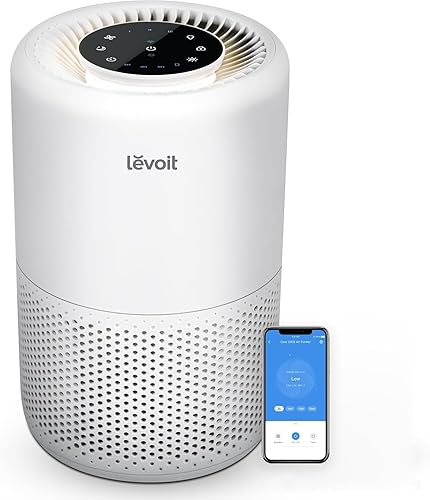
- Refreshes a 140 sq ft room 4.8 times per hour
- App feature monitors filter life
- Sleep noise as low as 27 dB
- 360-degree air intake
This compact pick is sized for a small room rather than an open living area. Its app feature can monitor filter life, while Sleep Mode keeps noise as low as 27 dB.
Pros
- Small-room coverage stated at 4.8 air changes per hour
- App filter-life monitoring
- Display can be turned off
Cons
- Limited to a small room at the faster cleaning rate
- Use genuine Levoit replacement filters
The Core 200S is designed for a small room, with a stated rate of 4.8 air changes per hour in 140 sq ft. Its 360-degree intake and compact size suit a bedroom, nursery or office where a larger unit would take up more space.
Sleep noise is as low as 27 dB, and you can turn off the display lights. The app feature lets you monitor filter life, while the three-stage filter uses a nylon pre-filter, main filter and activated carbon filter.
Levoit says the main filter removes 99.97% of dust, pollen and dander sized 0.1–0.3 microns. It recommends genuine replacement filters for the best performance and lifespan.
Choose it for a small bedroom or home office if app-based filter monitoring is useful. Skip it for a living room or open-plan space that needs more capacity.
Medify MA-25: Best for low-noise nurseries

- Coverage up to 825 sq ft in 1 hour
- H13 filtration claim
- Three fan speeds
- Lowest setting rated at 19.8 dB
A low noise claim of 19.8 dB and a child lock suit bedrooms or family spaces where quiet operation matters. Medify recommends replacing the filter after about 3–4 months of use.
Pros
- Lowest setting rated at 19.8 dB
- Three fan speeds and sleep mode
- Child lock
Cons
- Replacement filter interval is relatively short
- Coverage is stated for one hour
The Medify MA-25 focuses on quiet operation and simple controls. Its lowest setting is rated at 19.8 dB, and the touch panel includes three fan speeds, sleep mode, a timer and child lock.
Medify states coverage up to 825 sq ft in one hour and describes its dual filters as H13 filtration. Its replacement filter is rated for 2,500 hours, or about 3–4 months, depending on use and air quality.
That filter interval is shorter than the stated intervals for some other picks. Factor replacement frequency into your choice if you don't want regular filter upkeep.
Choose it for a quiet bedroom or family room where a child lock is useful. Skip it if less frequent filter changes are your main priority.
Winix A230: Best for automatic bedroom cleaning

- Air-quality sensor
- Auto Mode adjusts fan speed
- Carbon filter for household odors
- True HEPA
The sensor and Auto Mode can adjust fan speed as air quality changes, so you don't have to choose every setting manually. Its AHAM-verified room size is a more useful guide for faster cleaning than the maximum one-hour figure.
Pros
- Auto Mode adjusts fan speed
- Carbon filter for odors
- Air-quality monitoring
Cons
- Maximum area is tied to a one-hour cleaning figure
- App control is not specified here
The Winix A230 gives you sensor-based Auto Mode in a smaller body. Its AHAM-verified room size is 230 sq ft, while the maximum 1,110 sq ft figure corresponds to one hour of cleaning.
The carbon filter is designed to reduce household odors from cooking, pets and smoke. A built-in sensor measures air quality and adjusts fan speed in Auto Mode.
Winix says the True HEPA filter captures 99.97% of airborne allergens, including pollen, dust, smoke and pet dander. The A230 also uses PlasmaWave technology, which Winix says may help reduce airborne pollutants and impurities.
Choose it for a bedroom-size room where automatic fan changes are useful. Skip it if you want app control; remote app features are not specified for this model.
MOOKA KJ190H: Best for washable-pre-filter care

- Washable pre-filter
- PM2.5 display and Auto Mode
- Four fan speeds
- Timer options
A washable pre-filter and four fan speeds provide simple upkeep and control options. Its large coverage figure lacks an air-change rate here, so compare room-size claims carefully.
Pros
- Washable pre-filter
- PM2.5 display and Auto Mode
- Four fan speeds
Cons
- Air-change rate for the coverage figure is not specified here
- Essential-oil pad adds scent rather than removing its source
The MOOKA KJ190H stands out for its washable pre-filter, four fan speeds and PM2.5 display. Auto Mode can change fan speed based on detected air quality, and its timer offers 2, 4, 6 or 8 hours.
MOOKA gives a maximum coverage figure of 2,200 sq ft, but doesn't specify the air-change rate for that area. Compare the room-size claim with models that provide a clear cleaning rate before choosing it for a large space.
The pre-filter is washable, while the main filter and activated carbon pellets handle smaller particles and odors. MOOKA recommends cleaning or replacing the filter when its 2,000-hour reminder lights up.
Choose it if washable pre-filter care and flexible settings appeal to you. Skip it if a clearly stated cleaning rate for your room is essential to your decision.
Clorox Medium Room Air Purifier: Best for sensor-led living rooms

- Three-stage 360-degree filter
- Auto Mode
- PM2.5 display
- Filter interval of 6–12 months
This model gives a clear medium-room benchmark: up to five air changes per hour in 225 sq ft. The filter interval is 6–12 months, with a reminder light after 4,380 hours.
Pros
- Defined medium-room air-change rate
- Auto Mode responds to its air-quality sensor
- Filter interval of 6–12 months
Cons
- Best suited to medium rooms at the faster cleaning rate
- Filter replacement reminder still needs checking
The Clorox Medium Room Air Purifier gives you a defined cleaning rate for a medium room. It provides up to 5 air changes per hour in 225 sq ft, with a three-stage 360-degree filter.
An air-quality sensor adjusts fan speed in Auto Mode, and the PM2.5 display gives real-time feedback. The filter includes a pre-filter, True HEPA layer and active carbon layer; Clorox recommends replacing it every 6–12 months.
The filter reminder light comes on after 4,380 hours. Clorox's particle and virus claims describe results from independent testing, and the brand notes that results can vary with room shape, size, humidity and air quality.
Choose it for a medium room where a clear cleaning rate and automatic operation matter. Skip it for a larger room that needs the faster rate across more space.
How to choose the best air purifier under 200 dollars
Choose by room size and the air-change rate you want, then weigh filtration, noise, controls and replacement-filter care. A large maximum area can be less useful than a smaller room rating that states how often the air passes through the filter.
How do you match purifier coverage to your room?
Match the room's area to a stated cleaning rate, not just the largest coverage number. The Core 300-P states 4.8 air changes per hour in 222 sq ft, while the Shark HP152 covers up to 650 sq ft at one air change per hour.
Think about doors and room layout too. A purifier in a closed bedroom serves a different space from one in an open living and dining area, so choose for the area where you need the cleanest air.
If you have a compact bedroom, see our picks for the best air purifier for a small room. For a larger space, compare its dimensions and desired cleaning rate with the Vital 200S-P and Winix 5510 figures.
What does CADR tell you when buying an air purifier?
CADR gives a way to compare how quickly models deliver filtered air for specific particle types. The Vital 200S-P has separate smoke, dust and pollen figures, which help make it the clearest match here if one of those categories is a priority.
Room coverage and CADR answer related but different questions. Use the room rating to check fit, then use CADR figures where available to compare performance for smoke, dust and pollen.
For more background on filter choices, read our guide to the best HEPA air purifiers. It can help you compare filtration needs without treating every filter label as interchangeable.
Do you need a carbon filter for household odors?
A carbon filter can reduce some airborne odors, but it won't remove the source of a smell. The Winix 5510, A230, Core 200S and Clorox model include carbon filtration or an active carbon layer.
For cooking odors, run a purifier where it can draw in room air and ventilate the kitchen when practical. See our guide to air purifiers for cooking and kitchen smells for more on what filtration can and cannot do.
Persistent mustiness calls for a different first step. Address the moisture source before relying on a purifier, and read whether an air purifier can get rid of a musty smell.
Is a washable filter the same as a washable pre-filter?
No. A washable pre-filter or debris screen catches larger particles and can be cleaned, but that doesn't mean the main filter is washable.
MOOKA's pre-filter is washable, and Shark's Debris Defense screen can be cleaned.
Check the care instructions before rinsing any filter layer. A disposable main filter needs replacement when indicated, and washing a layer that isn't washable can damage it or reduce its performance.
The Shark HP152 is the standout here for a long-lasting main-filter claim. Compare its design with our guide to whether you can wash a HEPA filter.
Which controls and noise features matter in a bedroom?
For a bedroom, prioritize a low fan setting, dimmable or switchable lights, and a room rating that suits the space. The Core 300-P combines a 24 dB Sleep Mode with a stated 222 sq ft rate at 4.8 air changes per hour.
Auto Mode can suit you if you don't want to adjust speed manually. The Core 300-P has manual fan control, while the Winix and Clorox picks adjust fan speed based on a sensor.
If you run an air purifier for long periods, noise and filter upkeep both matter. Our guide on leaving an air purifier on all the time covers everyday use.
How should you set up and care for an air purifier?
Set the purifier where air can move through its intake and outlet, remove any protective packaging from the filter, and use the room-size guidance to choose a fan setting. Follow the model's instructions for filter access and cleaning.
Before turning it on, check that the filter is installed correctly and that any plastic wrapping is removed. MOOKA specifically instructs users to remove the protective bag from its filter before use.
Keep the intake and outlet clear of furniture, curtains and stored items. A blocked airflow path can limit how well the unit circulates room air, even when the purifier is running.
For routine care, clean only the parts the manufacturer identifies as washable. Vacuum or wash a pre-filter or screen as directed, let washable parts dry fully before reinstalling them, and replace the main filter according to its indicator and recommended interval.
Filter timing varies among these picks. The Core 300-P recommends replacement every 6–8 months, the Clorox filter every 6–12 months, and Medify rates its replacement filter for about 3–4 months depending on use and air quality.
What common mistakes should you avoid?
The most common mistake is buying for the biggest advertised area instead of the cleaning rate you need. A one-air-change-per-hour figure may be too slow for someone expecting frequent room cleaning.
Other mistakes include choosing a purifier that's too small for an open space, placing it where airflow is blocked, and assuming every filter can be washed. Avoid using added fragrance as a substitute for removing an odor source, especially if scents bother people in your home.
Don't ignore the recurring filter routine when comparing models. A washable screen can make care easier, but it doesn't remove the need to check the main filter or replace it when required.
Which air purifier under 200 dollars should you choose?
Choose the Vital 200S-P for a larger room with separate CADR ratings, the Core 300-P for a bedroom with a defined cleaning rate, and the Winix 5510 for app control plus odor features. Pick the Shark HP152 if fewer filter changes matter most and its one-air-change coverage fits your room.
For a small room with app-based filter monitoring, the Core 200S has a clear 140 sq ft rate. Choose Clorox for a medium room with a stated five-air-change rate, or Medify for a quiet low setting and child lock.
For a broader look at brands and models, browse our air purifier brand and model guide. To estimate ongoing power use, read how much electricity an air purifier uses.
Our top 3 picks at a glance
-
1
-
2
-
3
Frequently asked questions
What should I look for in an air purifier under 200 dollars?
Start with the room size at the air-change rate you want, then compare CADR, filter type, controls and replacement-filter needs. A large maximum coverage number may refer to only one air change per hour.
For a bedroom, noise and dimmable lights can matter as much as extra modes.
Is a higher coverage number always better?
No. Check how quickly the purifier cleans that area, since some figures mean one air change per hour while others describe several changes in a smaller room.
Match the purifier's stated room size and cleaning rate to the room where you'll use it.
Do air purifiers remove musty smells?
A carbon filter may reduce some airborne odors, but an air purifier won't fix the dampness or mold source that causes a musty smell.
Find and address moisture first, then use filtration as a supporting step. Our guide explains whether an air purifier can get rid of a musty smell.
How often do air purifier filters need changing?
It depends on the model and use. The Core 300-P recommends replacement every 6–8 months, the Clorox filter every 6–12 months, and Medify says its replacement filter lasts about 3–4 months.
Check the indicator and follow the instructions for your specific filter.
Should I leave an air purifier running all day?
That depends on your room, noise tolerance, filter upkeep and energy use. Many models offer sleep or Auto modes that can make longer operation easier, but use the controls that fit your space.
See our guide on leaving an air purifier on all the time for practical considerations.