9 Best HEPA Air Purifiers for the Home (October 2026)
The best HEPA air purifiers for home include the Levoit Core 300-P for bedrooms, the Winix 5510 for automatic air adjustment, and the Levoit Core 400S-P for large rooms.
On this page (7 sections)
- How we chose the best HEPA air purifier picks
- The best HEPA air purifiers for different rooms
- How do you choose the right HEPA air purifier?
- How should you set up and care for a HEPA purifier?
- What mistakes should you avoid when buying a HEPA purifier?
- Which HEPA air purifier should you choose?
- Frequently asked questions about the best HEPA air purifier
The best HEPA air purifier for most bedrooms is the Levoit Core 300-P, with AHAM verification, a quiet Sleep Mode and a filter check indicator. Choose the Winix 5510 for automatic fan adjustment, or the Levoit Core 400S-P for a larger room with app controls.
A good purifier needs the right combination of particle filtration, airflow and room fit. A large coverage number may describe only one air change per hour, so compare cleaning rates before matching a model to your room.
Start with our guide to choosing an air purifier for your home if you want a broader overview. For narrower spaces, see our best air purifiers for small rooms, and compare costs in our guide to air purifiers under 200 dollars.
Our picks at a glance
-
1

-
2

-
3

How we chose the best HEPA air purifier picks
These picks combine filtration details with room coverage, controls and care needs. We compared stated CADR and coverage figures, filter features, noise information and maintenance details against common home uses.
Coverage is most useful when you know the air-change rate behind it. A room-size figure based on one air change per hour describes a different cleaning pace from a figure based on 4.8 changes per hour.
| Product | Best for | Smoke CADR | Sleep mode | Controls | Our score |
|---|---|---|---|---|---|
| Levoit Core 300-P | bedrooms | 143 CFM | 24 dB | Touch; manual fan speed | 8.6 |
| Winix 5510 | automatic air adjustment | Auto Mode; app support | 8.5 | ||
| Levoit Core 400S-P | large rooms | 231 CFM | Auto Mode; app and voice control | 8.3 | |
| Medify MA-25 | quiet, simple controls | Touch panel; 0 to 8 hour timer | 7.7 | ||
| Blueair Blue Pure 511i Max | small smart spaces | Air quality sensors; app | 7.6 | ||
| DREO DR-HAP008 | live air quality readings | Auto Mode; AQI display | 7.4 | ||
| Honeywell AllergenPlus HPA104 | simple allergen capture | Three cleaning levels | 7.4 | ||
| KNKA APH4000 | washable pre-filter upkeep | 7.1 | |||
| GermGuardian AC4825E | a narrow tower footprint | Three speeds | 7.1 |
The best HEPA air purifiers for different rooms
The right model depends on your room, noise tolerance and preferred controls. The picks below remain in score order, with a distinct use case for each one.
Levoit Core 300-P: Best for bedrooms
- AHAM VERIFIED
- 143 CFM smoke CADR
- Sleep Mode as low as 24 dB
- Manual fan speed control
A compact choice for bedrooms and offices, with AHAM VERIFIED performance, a quiet sleep mode and a filter check indicator.
Pros
- AHAM VERIFIED
- Sleep Mode as low as 24 dB
- Display lights can be turned off
Cons
- No Auto Mode or smart connectivity
- 120V use in the United States
The Core 300-P fits a bedroom or office where you want straightforward controls and a quiet sleep setting. Levoit gives it AHAM VERIFIED CADR ratings of 143 CFM for smoke, 153 CFM for dust and 167 CFM for pollen.
Levoit describes the original filter as HEPA-grade while operating in Sleep Mode. It also reports 99.97% filtration efficiency for airborne particles from 0.1 to 0.3 microns.
Sleep Mode operates at 24 dB, and you can turn off the display lights. Fan speed is manual, so choose another model if you want a sensor to change the setting for you.
Buy this model for a bedroom where a quiet night setting and simple touch controls are enough. Skip it if you need app control or automatic fan adjustment, and remember that it uses 120V power for use in the United States.
Winix 5510: Best for automatic air adjustment
- AHAM Verified at 392 sq ft
- True HEPA
- Washable fine mesh pre-filter
- Air quality sensor and Auto Mode
Sensor-based Auto Mode adjusts fan speed as air quality changes, and the washable mesh pre-filter catches larger particles.
Pros
- Auto Mode with air quality sensing
- App support
- Sleep Mode activates when the room darkens
Cons
- Large-room coverage figures use different air-change rates
The Winix 5510 suits people who want a purifier to respond to changing air quality. Its sensor measures room air and adjusts fan speed in Auto Mode, while an indicator gives you a visual reading.
Winix says the True HEPA filter captures 99.99% of airborne allergens as small as 0.01 microns. A carbon filter targets household odors, and a washable fine mesh pre-filter catches larger particles.
The model supports app control and activates Sleep Mode when the room darkens. Its AHAM verification is at 392 sq ft; larger coverage claims use slower air-change rates.
Choose it if you prefer automatic adjustment and remote controls. Skip it if you want a purifier with only basic manual settings.
It may also be a poor fit if your room size depends on the larger, slower coverage figure. See our Winix 5520 air purifier review for a related model.
Levoit Core 400S-P: Best for large rooms
- 231 CFM smoke CADR
- Coverage up to 1,718 sq ft once per hour
- PM2.5 sensor
- App and voice control
This larger-room pick combines a higher smoke CADR with an air quality sensor, Auto Mode and app controls.
Pros
- AHAM VERIFIED CADR ratings
- Auto Mode responds to PM2.5 readings
- Sleep Mode as low as 24 dB
Cons
- One air change per hour is less frequent than smaller-room ratings
The Core 400S-P is the best fit here for a larger shared room where automatic response and app access matter. Its AHAM VERIFIED CADR ratings are 231 CFM for smoke, 240 CFM for dust and 259 CFM for pollen.
Levoit gives coverage up to 1,718 sq ft at one air change per hour. For a faster pace, compare CADR and coverage at the same air-change rate rather than using that large figure on its own.
A PM2.5 sensor shows readings in real time, and Auto Mode adjusts fan speed based on air quality. The VeSync app can adjust settings, set schedules and timers, and monitor filter life.
Choose it for a large room where automatic control and app access are useful. Skip it if your priority is frequent cleaning in a smaller room at a stated 4.8 air changes per hour, or if you don’t want connected features.
Medify MA-25: Best for quiet, simple controls

- True HEPA H13 filtration
- Three fan speeds
- Sleep mode dims panel lights
- Child lock
A touch panel, child lock and dimmable sleep mode make this a straightforward option for bedrooms and shared spaces.
Pros
- Three fan speeds and sleep mode
- Child lock
- Filter replacement indicator
Cons
- Replacement filter life is about 3 to 4 months
The Medify MA-25 offers direct controls for bedrooms and shared spaces. It has three fan speeds, a sleep setting, a child lock and a timer that runs from 0 to 8 hours.
Medify describes its True HEPA H13 filter as lab tested to remove 99.9% of particles down to 0.1 microns. It uses dual filters and has a replacement indicator.
Its lowest setting is rated at 19.8 dB, while the highest is 49.3 dB. Medify estimates filter life at about 3 to 4 months.
Choose this model if you want quiet low-speed operation, a child lock and simple touch controls. Skip it if replacing filters every few months is more upkeep than you want.
Blueair Blue Pure 511i Max: Best for small smart spaces

- HEPASilent dual filtration
- Air quality sensors
- App control
- 19 dB minimum noise
Its compact design and app controls suit a bedroom, dorm or home office where quiet operation matters.
Pros
- Quiet operation as low as 19 dB
- App control and filter reminders
- Compact design
Cons
- Large coverage figure is based on one air change per hour
The Blue Pure 511i Max is a compact smart purifier for a bedroom, dorm or home office. Blueair says it cleans 237 sq ft in about 12.5 minutes and up to 1,138 sq ft in one hour, with the larger area representing a slower air-change rate.
Its HEPASilent dual filtration is described as capturing 99.97% of airborne particles down to 0.1 microns. An air quality sensor can adjust fan speed, and the app provides monitoring, control and filter reminders.
The stated minimum noise level is 19 dB. Its compact design and 360-degree air intake give you more placement options in a small room.
Pick it if you want quiet operation and app-based control in a compact space. Skip it if you need a room-size estimate at a more frequent cleaning rate than the one-hour figure.
DREO DR-HAP008: Best for live air quality readings

- AHAM Verified at 115 CFM CADR
- PM2.5 sensor and AQI display
- Auto, Turbo and Sleep modes
- ENERGY STAR certified
A live PM2.5 display and several modes give you clear feedback and choices in a bedroom or smaller room.
Pros
- AHAM Verified performance
- Real-time AQI display
- Sleep Mode turns off display lights
Cons
- Best fit is a smaller room at a frequent air-change rate
The DREO DR-HAP008 is a compact pick for someone who wants live air quality readings and multiple operating modes. It is AHAM Verified at 115 CFM CADR and refreshes a 178 sq ft room every 12.4 minutes, or 4.8 times per hour.
DREO says the three-stage filter combines a pre-filter, high-efficiency filter and activated carbon layer to capture fine particles and help reduce household odors. Its 856 sq ft figure uses one air change per hour.
Auto Mode changes speed based on real-time air quality, and the purifier also has Turbo, Sleep and Normal modes. Sleep Mode turns off display lights, and the unit is ENERGY STAR certified.
Choose it for a smaller bedroom where a live PM2.5 reading and automatic speed changes are useful. Skip it if your main need is a verified frequent cleaning rate for a large room; the aroma box is optional, and essential oils aren’t included.
Honeywell AllergenPlus HPA104: Best for simple allergen capture

- HEPA filtration
- Three cleaning levels
- Turbo Clean
- Filter change indicator
Three cleaning levels, a timer and a filter change indicator make this a practical option if you prefer direct controls.
Pros
- Three cleaning levels including Turbo
- Filter change indicator and reset
- Control panel dimmer
Cons
- Confirm the exact model and dimensions before buying
The Honeywell AllergenPlus has three cleaning levels, including Turbo Clean, plus a filter change indicator and reset. Its controls include a 2, 4 or 8 hour shut-off timer and a dimmer for the control panel.
Honeywell says its HEPA filter traps up to 99.97% of microscopic airborne allergens and particles, including dust, pollen, pet dander, dust mite debris and smoke. The product information identifies this model as HPA104WMP, while some coverage and dimension details refer to HPA304.
That mismatch makes checking the exact model especially important before buying. Choose it if direct settings and a timer are your priority, and skip it if you need to be certain about room coverage before you can verify the model details.
KNKA APH4000: Best for washable pre-filter upkeep

- AHAM Verified
- Dual washable pre-filters
- Auto, Sleep, PET and ECO modes
- Real-time AQI display
Dual washable pre-filters and several operating modes offer flexible upkeep and settings for a range of household needs.
Pros
- AHAM Verified CADR
- Washable pre-filters
- Auto and ECO modes
Cons
- Main filters need replacement every 3 to 6 months
The KNKA APH4000 fits people who want a washable pre-filter and several operating modes. It has dual filter cartridges, a real-time AQI display and AHAM VERIFIED CADR ratings of 226 CFM for smoke, dust and PM2.5, plus 244 CFM for pollen.
KNKA states that it refreshes a 350 sq ft room 4.8 times per hour. Its broader 1,695 sq ft figure is based on one air refresh per hour, so use the smaller-room figure when frequent circulation matters.
The modes include Auto, Sleep, PET and ECO. KNKA says ECO mode enters standby when air quality is excellent, then restarts when purification is needed.
Choose it if washable pre-filter care and multiple modes suit your routine. Skip it if you prefer longer intervals between main-filter replacements, which KNKA recommends every 3 to 6 months.
GermGuardian AC4825E: Best for a narrow tower footprint
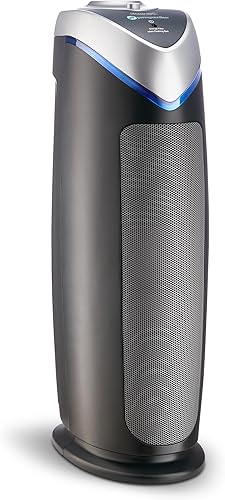
- HEPA PURE filter
- Activated carbon filter
- Three speeds
- Optional UV-C light
The tower shape and three speeds suit a smaller room where you want a simple control layout and carbon filtration.
Pros
- Tall, narrow tower design
- Activated carbon filter
- Three speeds including sleep mode
Cons
- UV-C light is optional
The GermGuardian AC4825E is a tower-style purifier with three speeds and an activated carbon filter. It circulates air in a 153 sq ft room every 12.5 minutes, while the 743 sq ft figure describes one air change per hour.
Its HEPA PURE filter captures 99.97% of allergens as small as 0.1 microns, according to the product description. The carbon filter reduces scents from cooking and pets; UV-C light is optional.
The tower measures 10.25 x 6.75 x 22 inches, so its narrow shape may fit a tight floor area. GermGuardian recommends its replacement filters and bulbs for certified fit and performance.
Choose it for a small bedroom or office where simple speed controls and carbon filtration are priorities. Skip it if you want app or sensor controls, or if you’re buying mainly for the optional UV-C feature.
How do you choose the right HEPA air purifier?
Choose by room size at a useful air-change rate, then compare filter design, controls and ongoing care. CADR helps you compare cleaning airflow, while the square-foot claim needs its air-change rate for context.
First measure the room where the purifier will run. For an open plan space, consider how the room connects to other areas and place the purifier where air can circulate freely.
A purifier rated for one air change per hour can claim a larger space than one sized for 4.8 air changes per hour. If you want frequent cleaning, prioritize a suitable CADR and a coverage claim at the rate you need, not the biggest square-foot figure.
What does a HEPA filter claim tell you?
A HEPA filter claim describes particle filtration, but terms and test details vary by model. Compare the stated particle size and efficiency, and look for independent verification or a CADR rating that helps you judge airflow.
The Core 300-P is described as HEPA-grade in Sleep Mode, while Winix calls the 5510 filter True HEPA. Medify describes its filter as True HEPA H13, and the Blueair uses HEPASilent dual filtration.
These terms don’t make the models interchangeable. Use the exact claim together with the room cleaning rate, not as a substitute for checking coverage.
Should you choose carbon filtration?
Choose a purifier with activated carbon if odors or some gases are part of your concern. The Winix 5510, Levoit Core 400S-P, DREO DR-HAP008 and GermGuardian AC4825E describe carbon filtration in their systems.
Carbon won’t remove the source of a persistent smell. Improve ventilation and address the source; for damp rooms, see our guide to whether an air purifier can help with a musty smell.
Which controls and noise features matter most?
Pick controls you’ll use consistently. A manual fan is straightforward, Auto Mode can adjust speed based on sensor readings, and app control can help you change settings or check air quality remotely.
For bedrooms, look for Sleep Mode, low-speed noise information and a way to dim or switch off display lights. The Core 300-P, Medify MA-25 and Blueair 511i Max each describe sleep-friendly features, but their controls and stated noise levels differ.
How should you set up and care for a HEPA purifier?
Set up a purifier with clear airflow around it, install its filter correctly and run it at a speed that fits the room and your noise needs. Regular pre-filter cleaning and timely main-filter replacement help keep airflow from being choked by collected debris.
Before the first use, check the manual and remove any protective packaging around the filter. The KNKA APH4000 specifically requires removing the filter’s plastic packaging before installation.
Keep air intake and outlet areas clear of walls, curtains and furniture. Avoid tucking a purifier behind a sofa or in a corner where the airflow path is blocked.
For a faster initial clean, use a higher fan setting if the sound is acceptable, then lower it when you want quieter operation. If the model has Auto Mode, check that the sensor area isn’t blocked and use the manual for its placement guidance.
Clean only parts the manufacturer says are washable. A washable pre-filter is not the same as a washable HEPA or main filter; see our guide on what you can wash in a HEPA filter.
Pay attention to filter indicators, but also follow the model’s care instructions. Filter life varies: Levoit recommends 6 to 8 months for the Core 300-P, Medify estimates 3 to 4 months for the MA-25, and KNKA recommends 3 to 6 months for the APH4000.
What mistakes should you avoid when buying a HEPA purifier?
The most common mistake is buying for the largest square-foot number without checking how often the purifier changes the air. A one-change-per-hour figure may suit a different expectation from a 4.8-change-per-hour rating.
Don’t assume every filter in the unit can be washed. Washable pre-filters catch larger debris, but the main particle filter usually needs replacement according to the specific model’s care instructions.
Avoid placing the purifier where its intake or outlet is blocked. Poor placement can limit circulation, even when the unit’s stated CADR and room coverage look suitable.
Don’t choose a purifier for odors based on particle filtration alone. Look for carbon filtration, and address the source of smoke, cooking smells or dampness as well.
Finally, factor filter replacement into your choice. A model that fits your room but needs a replacement schedule you won’t keep may be a poor match for your routine.
Which HEPA air purifier should you choose?
Choose the Levoit Core 300-P for a bedroom and a quiet sleep setting, the Winix 5510 for automatic fan adjustment, or the Core 400S-P for a larger room with app controls. Pick the Medify MA-25 for a child lock and direct controls, or the KNKA APH4000 if washable pre-filter upkeep matters.
The Blueair 511i Max suits compact smart spaces, while the DREO DR-HAP008 offers a live air quality display for a smaller room. The GermGuardian AC4825E favors a narrow tower form, and the Honeywell is worth considering only after you confirm the exact model and coverage.
Start with your room’s area and the air-change rate you want, then check noise, controls and replacement-filter care. For another brand comparison, read our Coway vs Blueair air purifier guide; for daily running costs, see how much electricity an air purifier uses.
Frequently asked questions about the best HEPA air purifier
What makes an air purifier a HEPA air purifier?
A HEPA air purifier uses a high-efficiency particle filter to capture airborne particles as air passes through it. Check the filter wording and the stated particle size and efficiency for the model you’re considering.
Some brands use terms such as HEPA-grade or proprietary filtration, so compare each claim with the purifier’s CADR and room coverage.
How do I choose the right HEPA purifier room size?
Match the purifier’s clean air delivery rate and room coverage to the space where you’ll use it. Compare coverage at the same air changes per hour, since a large square-foot figure based on one air change per hour is not equivalent to frequent cleaning.
Our air purifier size guide explains the room measurements to check.
Do HEPA air purifiers remove odors?
A HEPA filter captures particles, while odors and gases call for activated carbon. Several picks here combine particle filtration with carbon for household odors, but results depend on the odor source and the purifier’s design.
For persistent damp smells, address the moisture source as well as airborne particles.
Can I wash a HEPA filter?
Most HEPA filters shouldn’t be washed unless the manufacturer says they’re washable, because water can damage the filter media.
Some models have a washable pre-filter for larger debris while the main filter still needs replacement. See our guide to washing a HEPA filter for care tips.
Should a HEPA air purifier run all day?
An air purifier can run for long periods if its instructions allow it and you maintain the filter. A lower fan speed is quieter, while a higher speed moves more air.
Check our guide to leaving an air purifier on all the time for room placement and upkeep tips.
Our top 3 picks at a glance
-
1
-
2
-
3
Frequently asked questions
What makes an air purifier a HEPA air purifier?
A HEPA air purifier uses a high-efficiency particle filter to capture airborne particles as air passes through it. Check the exact filter wording and the particle size and efficiency claims for the model you’re considering.
Some brands use terms such as HEPA-grade or proprietary filtration, so compare claims carefully.
How do I choose the right HEPA purifier room size?
Match the purifier’s clean air delivery rate and room coverage to the space where you’ll use it. Compare coverage at the same air changes per hour, since a large square-foot figure based on one air change per hour is not equivalent to frequent cleaning.
Our air purifier size guide explains the room measurements to check.
Do HEPA air purifiers remove odors?
A HEPA filter captures particles, while odors and gases call for an activated carbon filter. Several picks here combine particle filtration with carbon for household odors, but results depend on the odor source and how much carbon the purifier contains.
For persistent damp smells, address moisture as well as airborne particles.
Can I wash a HEPA filter?
Most HEPA filters should not be washed unless the manufacturer says they are washable. Washing can damage filter media and reduce its ability to capture particles.
Some models have a washable pre-filter that catches larger debris, while the main filter still needs replacement.
See our guide to washing a HEPA filter.
Should a HEPA air purifier run all day?
An air purifier can run for long periods if its instructions allow it and the filter is maintained. A lower fan speed is quieter, while a higher speed moves more air.
Check our guide to leaving an air purifier on all the time for room placement and upkeep tips.