7 Best Air Purifiers for Basements (October 2026)
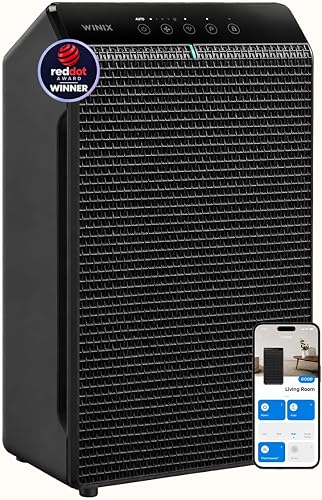
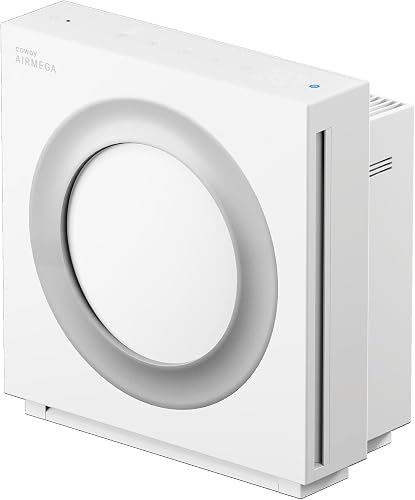
The best air purifiers for basements include the Winix 5520 for everyday basement rooms, the Coway Airmega Mighty2 for visible particle readings, and the Levoit Core 600S-P for open lower levels.
On this page (9 sections)
- How we chose the best air purifier for a basement
- Which best air purifier for basement fits each situation?
- How do you choose an air purifier for a basement?
- What size air purifier works in a basement?
- Can an air purifier solve a damp basement?
- Where should a basement air purifier sit?
- How do you maintain an air purifier in a basement?
- What mistakes should you avoid with a basement purifier?
- Which air purifier should you choose for a basement?
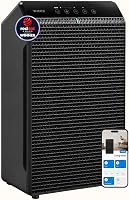
The Winix 5520 is the best air purifier for a basement room when its 392 sq ft AHAM-verified area fits your space and you want a carbon filter designed to reduce household odors. For an open lower level, compare faster room-cycle figures and place the purifier where air can circulate through the area you use.
A purifier can capture airborne particles and may help reduce some odors, but it doesn't dry a wet room or repair a leak. First identify and address moisture, then choose a purifier for the room's size, layout and air-quality concerns.
For a closer look at damp spaces, read our basement air purifier guide. The mold and musty room guide covers related air and moisture concerns.
Our picks at a glance
-
1
-
2
-
3

How we chose the best air purifier for a basement
We compared each purifier's stated coverage and interval, filter type, controls and maintenance features against common basement needs. The scores reflect how well those features fit a buyer choosing for room size, airborne particles, odor concerns and filter care.
Coverage numbers describe different cleaning intervals, so compare both the area and the time. A large square-foot figure at one air change per hour is a different fit from a smaller room rating at 12.5 or 30 minutes.
Basements also vary in layout and use. A finished room with a closed door needs a different plan from an open lower level, and one purifier may not circulate air through separate rooms.
| Product | Best for | AHAM verified area | Filter | Controls | Our score |
|---|---|---|---|---|---|
| Winix 5520 | everyday basement rooms | 392 sq ft | True HEPA and carbon | Air quality indicator and Auto Mode | 8.3 |
| Coway Airmega Mighty2 | visible particle readings | HEPA and active carbon | Smart Mode and air quality display | 8.2 | |
| Levoit Core 600S-P | open lower levels | 3-stage filtration | 8.0 | ||
| Winix AT40 | remote app control | 410 sq ft | True HEPA and carbon | WiFi, app and air quality display | 7.9 |
| Blueair Blue Pure 211i Max | faster open-room cycles | HEPASilent dual filtration | Sensors and app | 7.6 | |
| Medify MA-50 | timer-based use | HEPA H13 | 4 speeds, timer and filter indicator | 7.5 | |
| MOOKA KJ190H | washable pre-filter care | Washable pre-filter and HEPA filter | PM2.5 display, Auto Mode and 4 speeds | 7.1 |
Which best air purifier for basement fits each situation?
The Winix 5520 is a practical pick for a defined room, while the other models suit larger layouts, app monitoring, detailed readings or simpler pre-filter care. Start with your usable room area and the cleaning interval you want.
Winix 5520: Best for everyday basement rooms
- AHAM verified at 392 sq ft
- True HEPA filter
- Carbon odor-control filter
- Air quality sensor and Auto Mode
Its AHAM-verified area and carbon filter make it a practical fit for a basement room where airborne particles and household odors are concerns.
Pros
- AHAM verified at 392 sq ft
- Carbon filter is designed to reduce household odors
- Auto Mode adjusts fan speed
Cons
- The larger coverage figures use slower air-change intervals
- Measure your room against the AHAM-verified area
The Winix 5520 fits a basement room where you want particle filtration, sensor-based speed adjustment and help with household odors. It is AHAM verified at 392 sq ft, and Winix describes the carbon filter as designed to reduce VOCs and odors from cooking, pets and smoke.
Its sensor measures air quality and adjusts fan speed in Auto Mode. A washable fine-mesh pre-filter catches larger airborne particles before they reach the True HEPA filter.
Winix also gives larger coverage figures at slower intervals: 941 sq ft in 30 minutes and 1,882 sq ft in one hour. Use the 392 sq ft verified area as the more direct comparison if your priority is a quicker cleaning cycle.
Choose it for a defined basement room near that verified area, especially when odor reduction and automatic adjustment matter. Skip it for a large, open lower level if you expect the largest one-hour rating to clean as quickly as a smaller room rating.
Coway Airmega Mighty2: Best for visible particle readings
- Up to 900 sq ft in 30 minutes
- HEPA and active carbon filter
- Particle sensor and numerical display
- Washable pre-filter
A particle sensor with a numerical display gives you a visible air quality reading, while the washable pre-filter is easy to remove for care.
Pros
- Displays particle readings
- Washable pre-filter
- Smart Mode adjusts airflow
Cons
- The HEPA and carbon filter needs replacement
- Compare the 30-minute coverage claim with your room size
The Coway Airmega Mighty2 suits a basement where you want to see particle readings as conditions change. Its laser sensor detects PM1, PM2.5 and PM10, while the display shows both a color indicator and a numerical reading.
Coway describes its HEPA and active carbon filter as reducing airborne particles and some VOCs. Its washable pre-filter slides out for cleaning, and a filter-life display tracks the remaining life of the pre-filter and main filter.
The stated coverage is 900 sq ft in 30 minutes, or 1,800 sq ft in an hour. Use the 30-minute figure when comparing it with a room that needs a faster cleaning cycle.
Choose it if readable air-quality information and easy pre-filter access are priorities. Skip it if you only need a basic purifier and won't use the particle display.
Its main advantage is seeing readings and managing filter care. Our best air purifier for mold spores and musty rooms guide covers more options for particle and odor concerns.
Levoit Core 600S-P: Best for open lower levels
- 391 CFM CADR
- Up to 2,933 sq ft once per hour
- 3-stage filtration
- Auto Mode
Its stated coverage suits a large open area when you are comfortable with the once-per-hour rate. Levoit reports 99.97% filtration efficiency for airborne particles from 0.1 to 0.3 microns.
Pros
- Large stated coverage
- Auto Mode adjusts fan speed
- Original filter is HEPA-grade in Sleep Mode according to Levoit
Cons
- Coverage is stated at once per hour
- Check whether the open layout needs more than one unit
The Levoit Core 600S-P is designed for extra-large rooms and open floor plans. It has a stated CADR of 391 CFM, with coverage of 2,933 sq ft once per hour or 606 sq ft every 12.5 minutes.
Those figures help distinguish broad circulation from a faster cycle. The once-per-hour number may suit a large open area where steady background filtration is the goal; use the smaller, faster figure if your priority is more frequent air cleaning in a defined section.
Levoit rates its 3-stage filtration system at 99.97% efficiency for airborne particles from 0.1 to 0.3 microns. Auto Mode adjusts fan speed, and the Original Filter is HEPA-grade in Sleep Mode according to Levoit.
Choose it for a large, open lower level where airflow can reach the spaces you use. Skip it if your basement is divided by closed doors or you need a quicker cycle across the full area; one large coverage claim can't account for walls.
Use our air purifier room-size guide to compare room dimensions and coverage intervals.
Winix AT40: Best for remote app control
- AHAM verified at 410 sq ft
- True HEPA filter
- WiFi and Winix Smart App
- Air quality display
The app lets you monitor and control the unit remotely, while its AHAM-verified area helps set a realistic room-size target.
Pros
- AHAM verified at 410 sq ft
- App control and monitoring
- Includes 2 sets of all-in-one filters
Cons
- The larger coverage claim uses a one-hour interval
- Remote features depend on WiFi
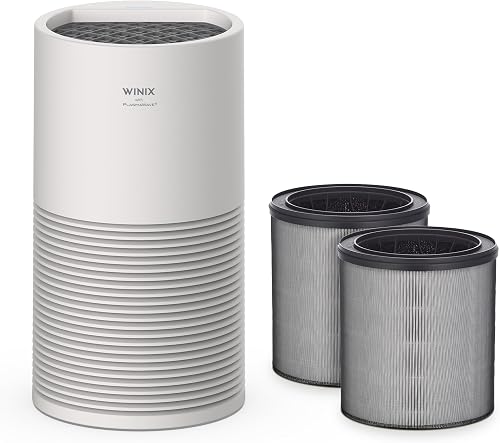
The Winix AT40 suits a basement where you want app access and a current air-quality display. It is AHAM verified at 410 sq ft, and its display pairs a digital readout with a color-coded indicator.
Winix includes 2 sets of all-in-one True HEPA filters. The unit also connects to the Winix Smart App over WiFi for remote monitoring and control.
Its larger coverage figures are 984 sq ft in 30 minutes and 1,968 sq ft in one hour. Use the 410 sq ft verified area to compare it with other room-focused options.
Choose it if remote control, a display and included spare filter sets make daily use easier. Skip it if you don't need WiFi or app controls.
The Winix 5520 offers a similar verified room-size class with odor-control details suited to a different priority. The basement air purifier guide has more on using a purifier in a damp space.
Blueair Blue Pure 211i Max: Best for faster open-room cycles

- Up to 674 sq ft in 12.5 minutes
- HEPASilent dual filtration
- Air quality sensors and app
- Washable fabric pre-filter
Blueair gives a faster coverage figure for 674 sq ft, which can help you compare it with the layout of a large finished basement.
Pros
- Coverage claim includes a 12.5-minute interval
- App and automatic fan control
- Washable fabric pre-filter
Cons
- Compare the coverage rate with your preferred air-change target
- The pre-filter does not replace the main filter
The Blueair Blue Pure 211i Max suits a large finished room where a faster coverage interval matters. Blueair gives a figure of 674 sq ft in 12.5 minutes and a one-hour coverage figure of 3,235 sq ft, so compare the interval that matches your goal.
Its HEPASilent dual filtration captures airborne particles such as dust, pollen, pet dander, smoke and mold particles, according to Blueair. Built-in sensors adjust fan speed, and the app lets you monitor air quality and track filter life.
A washable fabric pre-filter gives you a care step for larger particles, but it does not replace maintenance of the main filter. Keep both the room's layout and the time interval in mind when comparing this model with larger one-hour coverage claims.
Choose it for a broad room where app controls, automatic fan adjustment and the 12.5-minute coverage figure suit your needs. Skip it if you are choosing mainly for odor control or want to avoid app-connected features.
For persistent smells, read whether an air purifier can get rid of a musty smell.
Medify MA-50: Best for timer-based use

- Up to 1,320 sq ft in 30 minutes
- HEPA H13 filtration
- 4 fan speeds
- Timer and filter indicator
Four fan speeds, a timer and a filter indicator give you straightforward control options for a basement room.
Pros
- Four fan speeds
- Timer and filter indicator
- Coverage claim includes a 30-minute interval
Cons
- The stated filter replacement interval is about 3–4 months
- Compare coverage at the 30-minute rate with your room
The Medify MA-50 is a straightforward option if you want multiple speed settings and a timer. It has 4 fan speeds, a 0–8 hour timer, Sleep Mode and a filter replacement indicator.
Medify describes its filtration as HEPA H13 and says it captures particles down to 0.1 microns. Its coverage claim is 1,320 sq ft in 30 minutes, a useful interval to compare with your room and preferred cleaning pace.
Medify states that the replacement filter lasts 2,500 hours, or about 3–4 months. Air quality and use can affect how quickly a filter needs attention, so follow the indicator and model instructions.
Choose it when timer and speed controls matter more than app features. Skip it if you want app monitoring or a washable main filter.
If you plan to run a purifier for long periods, our guide to how much electricity an air purifier uses can help you think through operating time.
MOOKA KJ190H: Best for washable pre-filter care

- Washable pre-filter
- PM2.5 display and Auto Mode
- 4 fan speeds
- Timer
Its washable pre-filter and PM2.5 display suit buyers who want visible readings and a simple way to clear larger particles from the pre-filter.
Pros
- Washable pre-filter
- PM2.5 display and Auto Mode
- Four fan speeds and timer
Cons
- The 2,200 sq ft claim does not specify an air-change interval here
- Remove the filter's protective bag before use
The MOOKA KJ190H offers a washable pre-filter, a PM2.5 display and Auto Mode. It also has 4 fan speeds and timer settings, giving you several ways to adjust a basement room's operation.
MOOKA describes its design as 3-stage filtration with added activated carbon pellets to absorb unpleasant odors. Its 2,200 sq ft coverage claim doesn't specify an air-change interval, so it is harder to compare directly with models that give a time-based room rating.
The filter reminder lights after 2,000 hours, according to MOOKA. Remove the protective plastic bag from the filter before using the purifier.
Choose it if washable pre-filter care and visible PM2.5 readings appeal to you. Skip it if a clear coverage interval is central to your choice; compare the Winix 5520 or Blueair 211i Max instead.
How do you choose an air purifier for a basement?
Choose by the size of the space you want to clean, the stated air-change interval and the filtration features that match your concern. Measure the room, then compare the rating at a similar interval instead of sorting by the biggest square-foot number.
The Winix 5520 is AHAM verified at 392 sq ft. The Levoit Core 600S-P gives a much larger area once per hour, but it also states coverage of 606 sq ft every 12.5 minutes, which is the more useful figure for a faster cycle.
Consider your main problem next. For airborne dust, pollen or pet dander, look for a particle filter; for some household odors, a carbon filter may help.
If you want to see changing conditions, choose a model with a sensor and display or app.
Think about how much control you will use. Auto Mode can adjust fan speed based on sensor readings.
A timer and manual speeds suit people who prefer set operating periods. App control adds remote monitoring, but it is useful only if you want to manage the unit that way.
Filter care is part of the buying decision. Washable pre-filters can collect larger particles and need periodic cleaning, while the main filter still needs care or replacement as directed for that model.
What size air purifier works in a basement?
Match the purifier's room coverage to your measured floor area and note the air-change interval that goes with it. A coverage figure without a time reference is less useful for comparing how often the room's air passes through the purifier.
Measure the area you expect one unit to serve, especially if walls or doors divide the basement. A rating for an open area doesn't mean the unit will move air effectively into separate closed rooms.
If a model gives several figures, write down the area and time together. For example, the Blueair 211i Max states 674 sq ft in 12.5 minutes and 3,235 sq ft in one hour; those describe different cleaning paces.
Ceiling height and obstacles can also affect how air circulates through a room. Keep the unit's intake and outlet clear, and use more than one placement or unit if closed spaces cannot share airflow.
Can an air purifier solve a damp basement?
An air purifier filters airborne particles, but it does not remove water or repair the cause of dampness. Fix leaks, dry wet materials and address moisture before treating a purifier as the solution.
A carbon filter may help reduce some airborne odors, but that is different from moisture control. If a musty smell persists, inspect corners, stored items and areas near plumbing for damp materials or water intrusion.
A dehumidifier may help control excess moisture, while a purifier handles airborne particles. Our air purifier versus dehumidifier comparison explains which job each device can do.
Where should a basement air purifier sit?
Place the purifier on a dry, stable surface with open space around its intake and outlet. Keep it away from walls, stored boxes and damp areas that could restrict airflow or expose the unit to water.
Choose a spot near the area where you spend time, and follow the model's placement and clearance instructions. Avoid tucking the purifier behind furniture or into a corner where its airflow is blocked.
For a basement with several rooms, start with the room that needs the most attention. Closed doors limit air movement, so don't count on a single unit in one room to clean the air throughout the entire basement.
How do you maintain an air purifier in a basement?
Check the filter indicator and follow the cleaning or replacement schedule for your model. Wash a pre-filter only as directed, and don't wash a main HEPA filter unless its manufacturer says it is washable.
Basements can collect dust, lint and pet hair, so check any pre-filter regularly. Clean and dry washable parts fully before returning them, and keep the purifier away from moisture during cleaning.
Replace the main filter when the unit indicates or the model's instructions call for it. A washable pre-filter catches larger particles, but it does not remove the need to care for the main filter.
If the purifier itself develops an odor, check the filter and follow the care instructions. Our guide to why an air purifier may smell covers common causes and fixes.
What mistakes should you avoid with a basement purifier?
Don't choose by the largest coverage number alone. Check the time interval, and compare a room-size figure at a similar cleaning pace.
Don't expect filtration to resolve dampness or mold growth. An odor filter may help with some airborne smells, but water intrusion and wet materials need attention at the source.
Don't block the intake or outlet with furniture, storage or a wall. Restricted airflow can undermine the placement you chose, especially in a crowded basement.
Don't forget filter care after setup. A clogged pre-filter or overdue main filter can make the unit harder to use as intended, so set a reminder to check the indicator and clean washable parts as directed.
Which air purifier should you choose for a basement?
Pick the Winix 5520 for a defined room and a carbon odor-control filter, the Levoit Core 600S-P for a large open area where its coverage intervals fit, or the Blueair Blue Pure 211i Max when its 12.5-minute rating matches your room. Choose the Coway for readable particle data, the Winix AT40 for app access, the Medify for timer controls or the MOOKA for washable pre-filter care.
Before buying, measure the area, choose a realistic air-change interval and decide which controls you'll use. If dampness is the problem, address its source first; the best air purifier for basement use can support cleaner air, but it cannot dry a wet room.
Our top 3 picks at a glance
-
1
-
2
-
3
Frequently asked questions
What should I look for in an air purifier for a basement?
Match the purifier's coverage to your basement's floor area and the air-change interval behind that figure. A True HEPA or comparable particle filter can capture airborne particles, while a carbon filter may help reduce some odors.
If the basement is damp, address the moisture source too.
Can an air purifier get rid of a basement musty smell?
A purifier with a carbon filter may reduce some airborne odors, but it won't remove the cause of a musty smell if moisture or mold remains. Check for leaks, standing water and damp materials, then dry or repair the source.
See our guide to air purifiers and musty smells.
Should I use a dehumidifier with a basement air purifier?
A dehumidifier removes moisture from the air, while an air purifier filters airborne particles. They do different jobs, so a damp basement may need moisture control as well as filtration.
Our air purifier versus dehumidifier guide explains when each tool fits.
Where should I place an air purifier in a basement?
Place it where air can move around the intake and outlet, following the unit's clearance instructions. Keep it away from damp floors, water and obstructions, and choose a spot near the area where you spend time.
A basement with closed rooms may need separate coverage for each space.
How often should I replace a basement air purifier filter?
Follow the filter indicator and the instructions for your specific model. Dust, smoke, pets and continuous use can affect how quickly a filter needs attention.
Clean a washable pre-filter as directed, but don't wash a HEPA filter unless its manufacturer says it is washable.