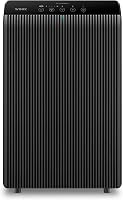
3-in-1 Filter vs HEPA Filter Purifiers: What Differs? (November 2026)
A 3-in-1 filter is a HEPA-grade filter plus a pre-filter and a carbon layer in one cartridge, so the real comparison is not either/or. The 3-in-1 saves time and usually costs less to maintain, while a separate HEPA filter with washable pre-filter lets you replace only the part that wears out.
On this page (9 sections)
- What does a 3-in-1 filter actually contain?
- How is that different from a separate HEPA filter?
- Which is cheaper to keep running?
- Which handles odors and smoke better?
- Does coverage change with the filter type?
- Which type suits a bedroom?
- What about pets, dust and allergies?
- Which should you buy?
- The verdict on 3-in-1 vs HEPA filters
A 3-in-1 filter is not the opposite of a HEPA filter: it's a HEPA-grade particle layer bundled with a pre-filter and a carbon stage in one cartridge. So the real "air purifier 3 in 1 filter vs hepa filter" question is about maintenance, not filtration.
A standalone HEPA filter, often behind a separate washable pre-filter, lets you replace each layer when it wears out. A 3-in-1 cartridge asks you to swap the whole stack at once.
Which one fits you depends on how much odor and smoke you deal with and how much fiddling you want at filter-change time. The products below show both approaches.


What does a 3-in-1 filter actually contain?
A 3-in-1 filter is three layers stacked in a single cartridge: a pre-filter for hair and dust, a HEPA-grade layer for fine particles, and a carbon layer for odors. The name describes the stack, not a separate filtration standard.
The pre-filter is the outer screen. It catches pet hair, lint and larger dust before they reach the fine layer, which is why it clogs first.
A well-built 3-in-1 gives that screen a decent surface area, so it takes longer to load up with hair than a thin outer wrap would.
The HEPA-grade layer does the particle work. Levoit says its Original Filter is HEPA-grade while running in Sleep Mode and captures 99.97% of particles from 0.1 to 0.3 μm, tested by an independent lab.
The carbon layer sits behind or inside that layer. It handles cooking smells, smoke and pet odors, though the amount of carbon varies a lot between cartridges.
That variance is the single biggest difference between one 3-in-1 and another.
Where the "HEPA-grade" wording matters
A 3-in-1 cartridge is rarely sold as a certified HEPA filter. The maker says the particle layer is HEPA-grade, which means the material meets the efficiency bar but the whole cartridge was not necessarily tested as a sealed HEPA unit.
Levoit's claim is tied to Sleep Mode, so the particle layer is rated at low fan speed. That is the speed you actually run at night, which makes the claim useful rather than decorative.
When you compare two 3-in-1 cartridges, check what the efficiency figure is attached to. "HEPA-grade at Sleep Mode" tells you more than a bare "HEPA" badge with no speed or particle size named.
How is that different from a separate HEPA filter?
A separate HEPA filter is just the particle layer, so the purifier adds its own pre-filter and often its own carbon filter as separate parts. Coway's AP-1512HH is the clearest example in this group.
Coway lists a four-stage system: a washable pre-filter, a deodorization filter, a bipolar device and a HEPA filter. The pre-filter rinses clean, and the deodorization filter handles gases and odors.
The particle layer reduces 99.97% of 0.3 micron particles, including pollen and other allergens, and also reduces volatile organic compounds and odor. Those are separate jobs done by separate parts.
Coway's HEPA filter is also sold against a published standard. The maker says the HEPA filter complies with IEST-RP-CC007 at speed level 1 as tested by SGS.
A named standard and a named testing lab are the kind of detail a 3-in-1 cartridge label often skips.
The practical difference is granularity. With separate filters you replace only what's spent.
With a 3-in-1 you replace the stack, which is simpler but less precise.
Which is cheaper to keep running?
A 3-in-1 cartridge usually costs less to maintain over a year because it's one part instead of three, but you replace more of it each time. The separate-filter setup wins when its pre-filter is washable.
With a 3-in-1, the pre-filter, particle layer and carbon all leave together. If the carbon is spent but the particle layer still has life, you still replace the whole cartridge.
That wasted life is the hidden cost of the simpler design.
Levoit recommends replacing its 3-in-1 filter every 6 to 8 months. FULMINARE says its filter lasts about 3 months normally.
Both are single-cartridge swaps, and the gap between 3 and 8 months is large enough to change your yearly spend on its own.
The Coway's washable pre-filter changes the math. You rinse it, replace only the HEPA and deodorization filters, and skip a whole replacement category.
Coway also sells the filters as separate parts, so each one gets its own replacement schedule.
For a smoky home, the separate setup also protects the expensive HEPA layer. A pre-filter you clean keeps soot off the particle filter.
In a 3-in-1, soot lands straight on the particle layer and pushes the whole cartridge toward replacement sooner.
If you want the least upkeep, an air purifier with washable filter built into the design is worth a look before you settle on a cartridge-only model. The washable part does the dirty work, so the fine filter lasts longer whichever type it is.
Which handles odors and smoke better?
The carbon layer decides odor performance, and a dedicated deodorization filter usually holds more carbon than the thin layer in a 3-in-1 cartridge. That matters most for smoke and pet odors.
Coway's deodorization filter was tested by KCL to reduce harmful gases and odors within 30 minutes, including key VOCs and pollutants. That's a dedicated filter with its own test and its own replacement part.
Coway's activated carbon filter was also tested by KCL and shown to reduce various harmful gases and odors within 30 minutes, and the company reports tests on ammonia and hydrogen sulfide reduction over 30 minutes. Those gases are the ones you notice from pets and stale rooms.
A 3-in-1 cartridge's carbon is often a thin mat bonded to the HEPA layer. It handles light cooking smells and everyday pet odor, not heavy smoke over months.
Once that thin mat is saturated, the whole cartridge has to go.
MOOKA's 3-stage filter uses more activated carbon pellets to absorb odors and adds an aromatherapy pad for scent. It's built around pet hair and smell.
The aromatherapy pad covers a smell rather than removing it, so treat it as a comfort feature, not a filtration stage.
If wildfire smoke or cigarette smoke is your main problem, the separate deodorization filter is the safer choice. For light kitchen smells, a 3-in-1 does the job.
Does coverage change with the filter type?
No, coverage is set by the fan and cabinet, not by whether the filter is 3-in-1 or separate. A purifier's room rating comes from how much air it moves through whatever filter it holds.
FULMINARE rates its H13 unit for up to 1,086 ft² based on 5 air changes per hour. That's a high number for such a small cabinet, so treat it as the best case.
The figure assumes the fan keeps turning the room over five times an hour, which is a fast pace for a unit this size.
Levoit gives 222 ft² at 4.8 air changes per hour and 1,073 ft² once per hour. The second number describes a slow single pass, not a fast clean.
Levoit also publishes CADR figures for its Core 300-P: 143 CFM for smoke, 153 CFM for dust and 167 CFM for pollen. Those numbers let you compare it to another purifier without trusting the room rating alone.
Coway covers up to 1,748 ft² in 60 minutes. MOOKA claims up to 2,200 ft².
Both are larger rooms than the bedside units handle.
Compare coverage figures at the same air-change rate. Our guide to choosing the best air purifier for your home explains how to match a rating to your room size.
A 1,086 ft² rating at five air changes per hour and a 1,748 ft² rating at one pass per hour describe very different cleaning speeds.
Which type suits a bedroom?
A 3-in-1 or H13 unit with a quiet sleep mode suits a bedroom, as long as its coverage matches the room. Noise and light matter more than the filter label at night.
FULMINARE's unit runs at about 20 dB on low fan speed and adds a night light and five timers. It's 5.71 inches square and 7.88 inches tall, so it fits a nightstand.
The timers run 2, 4, 8, 10 and 12 hours, which covers a nap and a full night's sleep.
Levoit's Core 300-P runs at 24 dB in Sleep Mode and lets you turn the display lights off. It weighs 7.9 pounds and is rated for 222 ft².
It also has a 2, 4, 6 or 8 hour timer and a check filter indicator.
A 3-in-1 cartridge means one swap when the filter is due. In a bedroom with normal dust and pet dander, that's the simpler upkeep.
You don't have to remember which layer is due next.
For smoke or heavy odors in the bedroom, the Coway's separate filters and deodorization stage are the better fit. It's bigger and heavier at 12.5 pounds, so give it floor space rather than a shelf.
It also has a filter change indicator, so you don't have to guess when a part is spent.
If you want the best particle performance in a bedroom and don't mind a single cartridge, the best HEPA air purifier picks cover both approaches.
What about pets, dust and allergies?
For pets and dust, either filter type works if the pre-filter catches hair before it reaches the fine layer. A washable pre-filter is the bigger advantage here than the HEPA label.
MOOKA's larger front inlet and dual-side inlets pull air from several sides and trap airborne pet hair. Its washable pre-filter saves replacement cost and extends the HEPA filter's life.
A wide inlet matters for pet homes because hair collects at the intake, not deep in the filter.
Coway's washable pre-filter does the same job for pet hair and dust. Its HEPA layer then works on the fine particles that get past the screen.
Between the two, the Coway's separate parts mean you can swap the HEPA layer without buying a new deodorization filter at the same time.
A 3-in-1's pre-filter isn't washable in most cartridges. It fills with hair and then goes in the bin with the rest of the stack.
That is the one clear weakness of the 3-in-1 design in a shedding household.
If you have a heavy-shedding dog or cat, the washable pre-filter models stretch your filter budget. For light shedding, the 3-in-1's simpler swap wins.
HEPA-grade particle capture matters most for allergy sufferers. A HEPA vs non-HEPA purifier comparison explains what the grade actually guarantees.
In short, the grade tells you how well the particle layer catches fine matter, not how well the unit handles gases.
Which should you buy?
Pick a 3-in-1 purifier if you want one filter to swap and light odor control; pick a separate-filter purifier if smoke, pets or allergies mean you'll replace parts often. The right answer follows your air problems.
The FULMINARE unit is our top pick for most people in this comparison. Its H13 HEPA filter, 20 dB sleep setting, night light and five timers make it a strong bedroom choice, and its single cartridge keeps upkeep simple.
The 9.6 score reflects that fit for a typical bedroom buyer. Remember its filter is a replaceable part with a roughly 3 month normal interval, so budget for that.
The Coway Airmega AP-1512HH is the best pick for smoke and odors. Its washable pre-filter, deodorization filter and auto mode handle gases that a 3-in-1's thin carbon layer struggles with.
It's the 8.7 choice for a living room or a smoky home. The auto mode reads the air quality and adjusts the fan on its own, so you don't have to.
The Levoit Core 300-P shows what a 3-in-1 does well. It's rated for 222 ft², runs at 24 dB in Sleep Mode and uses one pre-installed cartridge.
Pick it for a small bedroom or office on a modest budget. It is the only one in this group without auto mode, so you set the fan speed yourself.
MOOKA's KJ190H is the pet-home pick. The washable pre-filter, PM2.5 display, auto mode and aromatherapy pad suit a larger room with shedding pets, though its 7.1 score reflects the higher maintenance load.
Its filter reminder comes on at 2,000 hours and needs a long press to reset after cleaning or replacing.
The verdict on 3-in-1 vs HEPA filters
The air purifier 3 in 1 filter vs hepa filter choice comes down to upkeep: one cartridge to swap, or separate layers you replace individually. Neither filters better on its own; the particle layer in a good 3-in-1 is HEPA-grade.
For most bedrooms and light odor, a 3-in-1 unit like the FULMINARE is the easier buy. For smoke, pets and allergies, the separate-filter Coway earns its keep with a washable pre-filter and a real deodorization stage.
The MOOKA sits between the two, with a 3-stage stack and a washable pre-filter for a larger pet room.
Whichever you pick, check the filter type before you buy and plan the replacement cost. Our best HEPA air purifiers guide sorts the top units by filter design and room size.
Frequently asked questions
Is a 3-in-1 filter the same as a HEPA filter?
No, a 3-in-1 filter is a stack of layers that includes a HEPA-grade particle layer, while HEPA describes that particle layer alone. The 3-in-1 adds a pre-filter and a carbon stage in the same cartridge, so it filters more kinds of things but wears out as a unit.
Do 3-in-1 filters cost more to replace than plain HEPA filters?
Usually less over a year, because one 3-in-1 cartridge replaces what might be three separate filters. The trade-off is that the whole cartridge goes when the carbon is spent, even if the particle layer still has life left.
Can I wash a HEPA filter?
No, never wash a HEPA or HEPA-grade particle layer; water damages the fiber mat and it stops filtering properly. Only washable pre-filters are meant for rinsing, and even then let them dry fully before putting them back.
Does a 3-in-1 filter remove odors and smoke?
It can help with odors and smoke through its carbon layer, but the amount of carbon matters more than the label. Thin carbon cloth in a 3-in-1 cartridge handles light cooking smells; a dedicated deodorization filter like the one in the Coway holds more for smoke and pet odors.
How often should I replace a 3-in-1 filter?
Follow the maker's interval for your model and how dirty your air gets. FULMINARE says its filter lasts about 3 months normally, while Levoit recommends 6 to 8 months for its 3-in-1 filter, so the label matters more than a general rule.
Which type is better for allergies?
Both can help if the particle layer is HEPA-grade. A separate HEPA filter with a washable pre-filter is the more practical allergy choice in a smoky or dusty home, because the pre-filter catches the big stuff and keeps the HEPA layer working longer.